

Getting the call that your car has been declared a "total loss" is disorienting — one day you're waiting on a repair estimate, the next you're being told the car itself is essentially over, at least from the insurer's point of view. What most policyholders don't realize is that this moment isn't the end of the process — it's the start of a second, less-discussed one: figuring out what happens to the wrecked vehicle itself, and how to actually sell the salvage for a fair price.
This guide walks through how total-loss settlements generally work in India, and how Aslam Salim Motorwala buys total-loss and salvage vehicles across Mumbai, Pune, Thane, and Navi Mumbai.
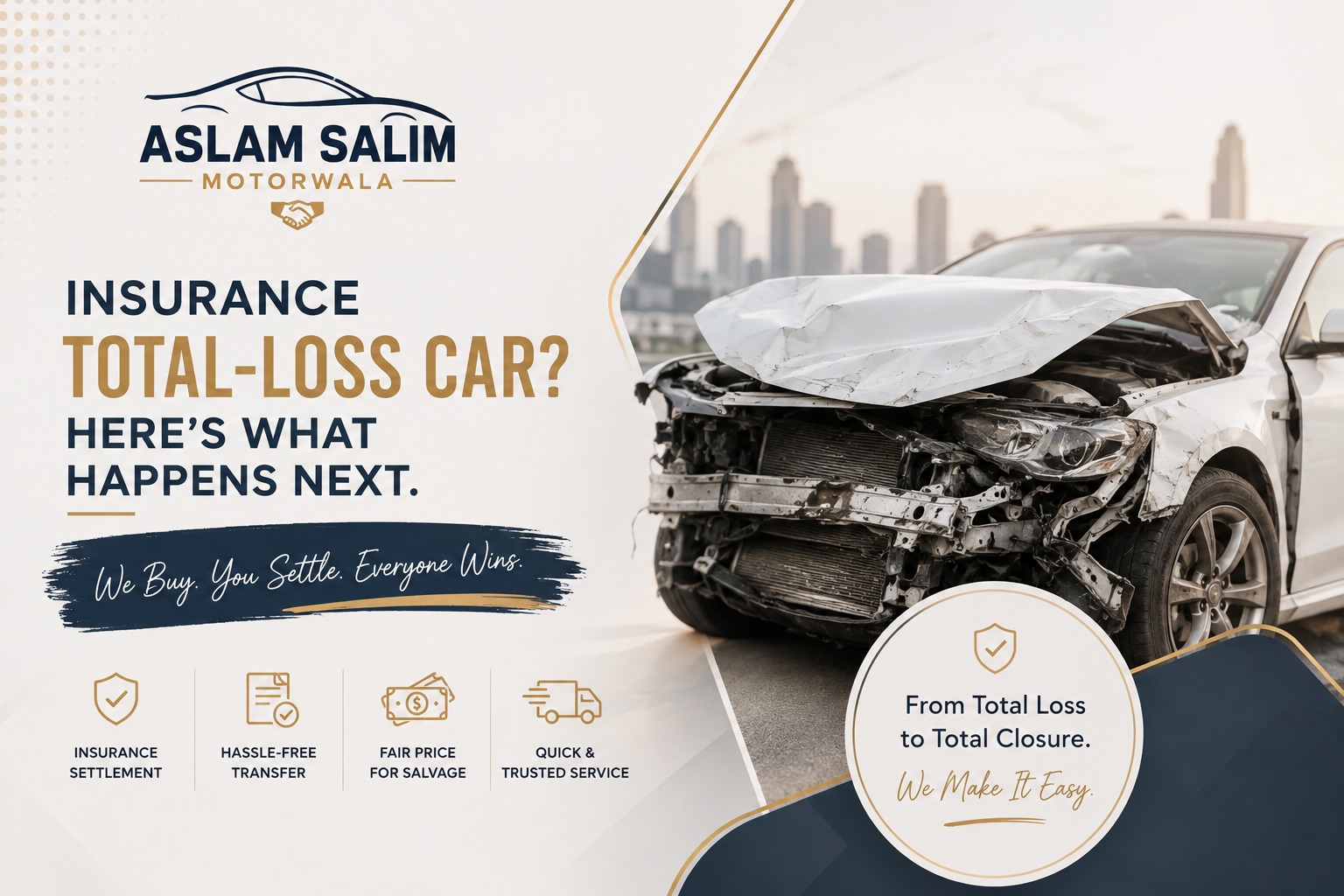
What "Total Loss" Actually Means
In India, total-loss determinations are generally governed by the framework set out under the Motor Vehicles Act and IRDAI guidelines, with a car typically classified as a Constructive Total Loss (CTL) when the estimated cost of repairing accidental damage exceeds roughly 75% of the vehicle's Insured Declared Value (IDV) — the maximum amount an insurer has agreed to pay out for that specific vehicle. Once a surveyor confirms the vehicle can't be repaired economically or safely, the claim generally moves toward settlement rather than repair.
Where the Salvage Comes In
Once a total-loss settlement is finalized, the damaged vehicle itself — the "salvage" — still belongs to someone, and still has real value. Depending on how the claim is structured, the salvage may go back to the insurer, or the policyholder may retain it and be responsible for selling it separately. Either way, someone eventually needs to find a buyer for that damaged vehicle — which is exactly where a dedicated accidental and salvage car buyer becomes genuinely useful.
Why a Damaged Car Still Has Real Value
Accidental cars typically retain 60–80% of the indicated value range — a meaningful percentage, depending on kerb weight, condition, and current scrap metal market rates. This applies directly to total-loss salvage vehicles too: the fact that an insurer has deemed a car uneconomical to repair doesn't mean the vehicle itself is worth nothing. Metal, working parts, and materials all still carry genuine resale and recycling value.
The Common Scenarios Handled
| Scenario | What It Means |
|---|---|
| Constructive Total Loss (CTL) | Repair cost exceeds roughly 75% of the vehicle's IDV, and the insurer settles the claim rather than funding repairs. |
| Actual Total Loss | The vehicle is completely destroyed or unsafe to be repaired at all. |
| Insurance write-offs | Including insurance write-offs from Mumbai-Pune Expressway accidents — a real, recurring scenario given how frequently serious accidents occur on that route. |
| Cash-loss settlements | Where repair costs are high but below the CTL threshold, and a negotiated settlement is reached instead. |
How Selling the Salvage Actually Works
Why Proper Documentation Matters Even More Here
A total-loss vehicle already involves an insurance claim on record — meaning the paperwork trail around it matters more, not less, compared to a routine used-car sale. Selling a car for scrap or as accident-damaged requires basic legal paperwork to ensure the car is permanently de-registered from your name at the relevant RTO. Skipping this is exactly what leaves owners exposed to legal liability long after the settlement check has cleared and the car has been towed away.
Why Fair Pricing Matters More for Total-Loss Vehicles
Most car scrap dealers cut hidden commissions, manipulate quotes at pickup, and skip RTO formalities — leaving customers exposed to legal liability. For a total-loss vehicle specifically, owners are often already dealing with insurer negotiations and may not have the energy to also scrutinize a second, separate salvage transaction closely. That's exactly the situation where working with a transparent, established buyer matters most.
A Track Record Built for This Exact Situation
Aslam Salim Motorwala has been operating as an authorised car scrap dealer in the Mumbai-MMR-Pune belt since 2005, with over 20 years of experience in vehicle dismantling, parts recovery, and metal recycling, and a 4.8★ rating across 127+ reviews.
Where This Service Operates
Coverage spans Mumbai (all suburbs), Pune (IT Hub West, Central, East, PCMC Belt, Industrial MIDC, South, North, Hadapsar-Camp), Thane (including Ghodbunder Road, Kalyan, Bhiwandi), and Navi Mumbai (Vashi & APMC, Nerul-Seawoods, CBD Belapur, Kharghar Township, Panvel-Kalamboli, Industrial Corridor, Ulwe-NMIA, JNPT Port Belt) — with free doorstep pickup extending across all these areas.
A Practical Checklist After a Total-Loss Declaration
- Confirm who owns the salvage. Understand whether the insurer or you personally retain the right to sell the damaged vehicle before moving forward.
- Don't assume the salvage is worthless. Accidental and damaged vehicles typically retain a meaningful 60-80% of their indicated value range.
- Get an independent quote for the salvage, separate from your settlement. These are two different transactions — don't let one cloud your understanding of the other.
- Insist on free towing. A total-loss vehicle likely isn't driveable, and towing shouldn't add extra cost or hassle to an already stressful process.
- Confirm RTO deregistration is handled. This step protects you from any future liability tied to a vehicle that already has an insurance claim on record.
Get a Fair Quote for Your Total-Loss Vehicle
Free towing, transparent pricing, and complete RTO documentation for total-loss and salvage vehicles across Mumbai, Pune, Thane, and Navi Mumbai.
Call 7428590020 →Frequently Asked Questions
My car was declared a total loss but it still runs — is it really worth selling as salvage?
Yes. Total-loss classification is generally about repair economics rather than the car's exact physical condition, and accidental/damaged cars typically retain 60-80% of their indicated value range regardless of whether they're currently driveable.
Do you tow non-drivable total-loss vehicles?
Yes — free towing is provided even for non-running or badly damaged vehicles, at no cost.
Will the vehicle be properly deregistered after I sell the salvage?
Yes. The scrapping intimation is filed with the relevant RTO, and a Certificate of Deposit is issued, with the vehicle permanently de-registered within 2-4 weeks.
Which areas are covered for total-loss and salvage pickup?
Mumbai, Pune, Thane, and Navi Mumbai, with free doorstep pickup extending across all major areas in each city.
Final Thoughts
A total-loss declaration can feel like the end of the story, but for the vehicle itself, it's really just a transition into a second, separate transaction — selling the salvage for what it's genuinely worth. Too many owners, already worn down by insurer negotiations, accept the first vague offer that comes along for the damaged vehicle rather than seeking a transparent, fair quote.
With free towing, pricing based on real market value rather than guesswork, and complete RTO deregistration, Aslam Salim Motorwala offers a straightforward way to close out the total-loss process properly — across Mumbai, Pune, Thane, and Navi Mumbai.